
Situational Intelligence for the Sun.
Artificial Intelligence has quietly begun to transform how we study and predict the multitude of complex interactions with our nearest star. And that’s a big deal.
For over a decade, the Frontier Development Lab has stood at the crossroads of AI, heliophysics, and space science. Partnering with NASA’s Heliophysics Division, our amazing Heliolab researchers, have achieved many AI firsts, all pragmatic advances that expand the boundaries of discovery, one model at a time. Among them: the first application of AI to fix a broken instrument (SDOML) and the earliest demonstrations of virtual instruments that allowed us to view the ‘unseen’ - such as the solar poles - and many others. This year, the research frontier advanced again with the introduction of chained AI and foundation models, breakthroughs in AI architecture that promise to accelerate how we perceive, model, and interpret the Sun’s behavior.
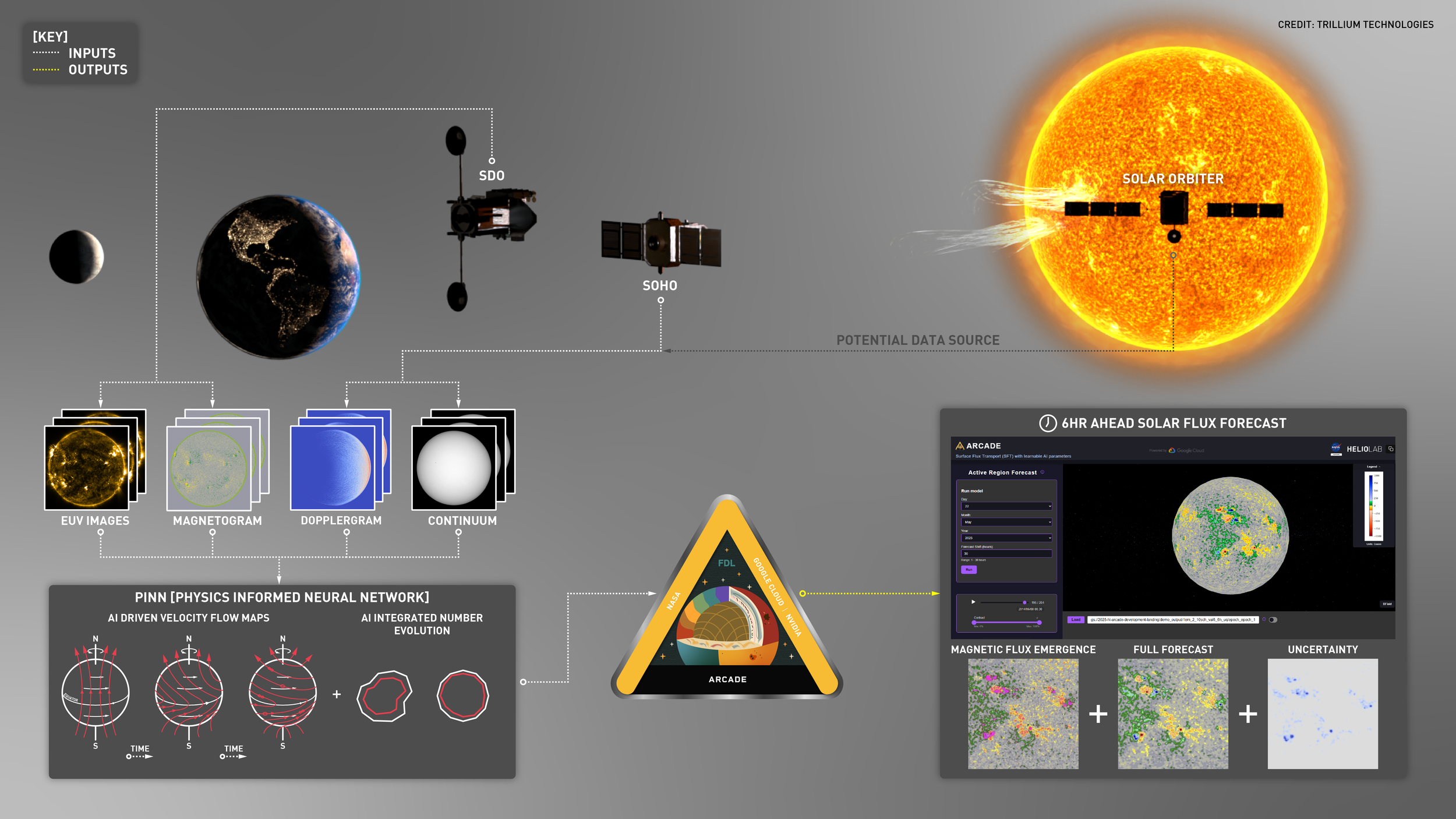
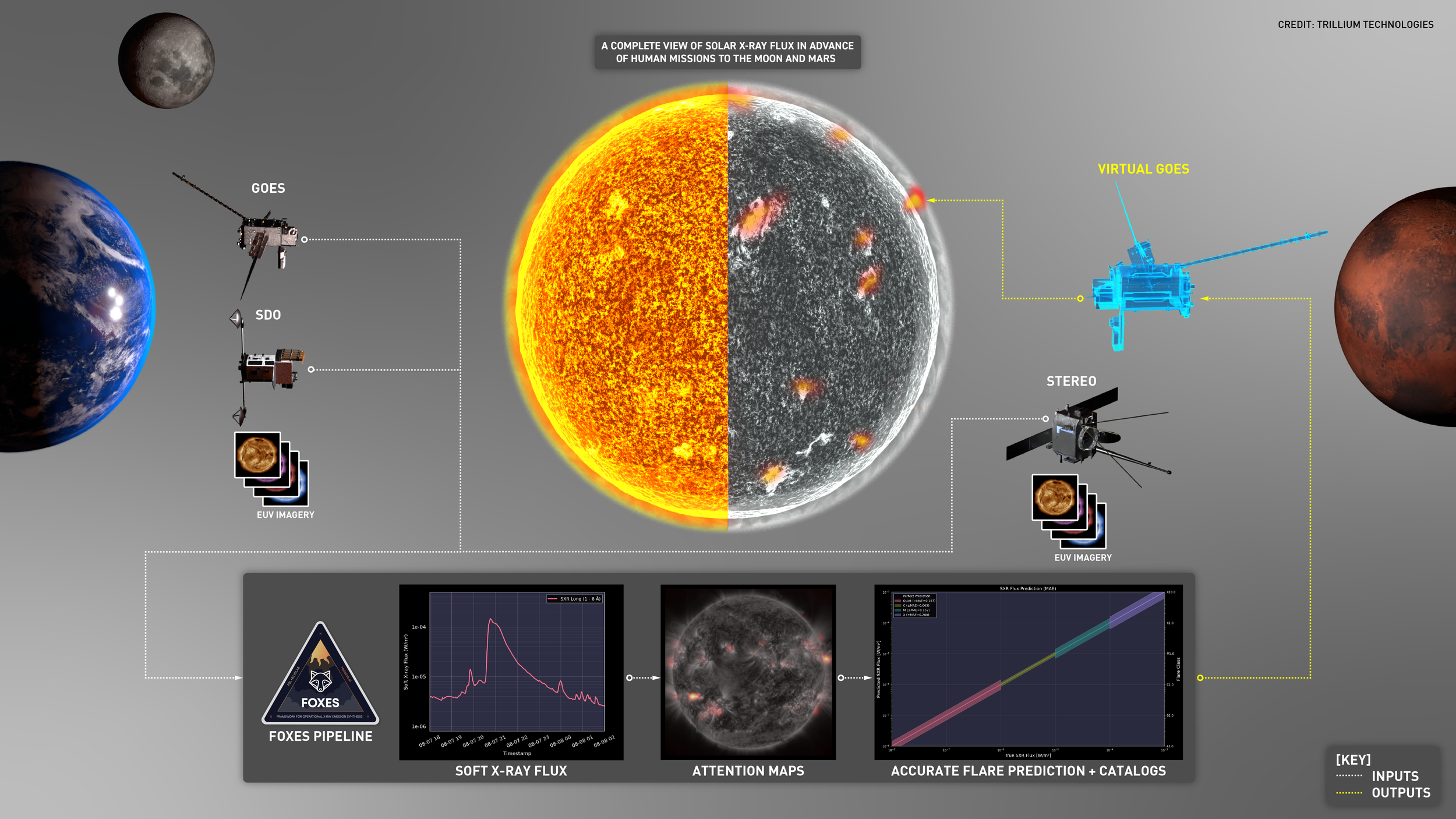
AI is unlocking multiple vantage-point science in heliophysics; from Parker Solar Probe to Stereo and the Solar Dynamics Observatory and allowing them to collaborate in real time. Instrument-to-Instrument Translation (ITI) enables spacecraft to work in concert, creating a fused, multi-perspective view of the Sun’s evolving magnetic landscape. Through this kind of orchestration, we are now able to predict active regions and model solar wind streams as living, dynamic structures, detailed in the work of this year’s Active Region Characterization and Multi-model Flare Prediction teams, shared in this publication for the community for the first time.
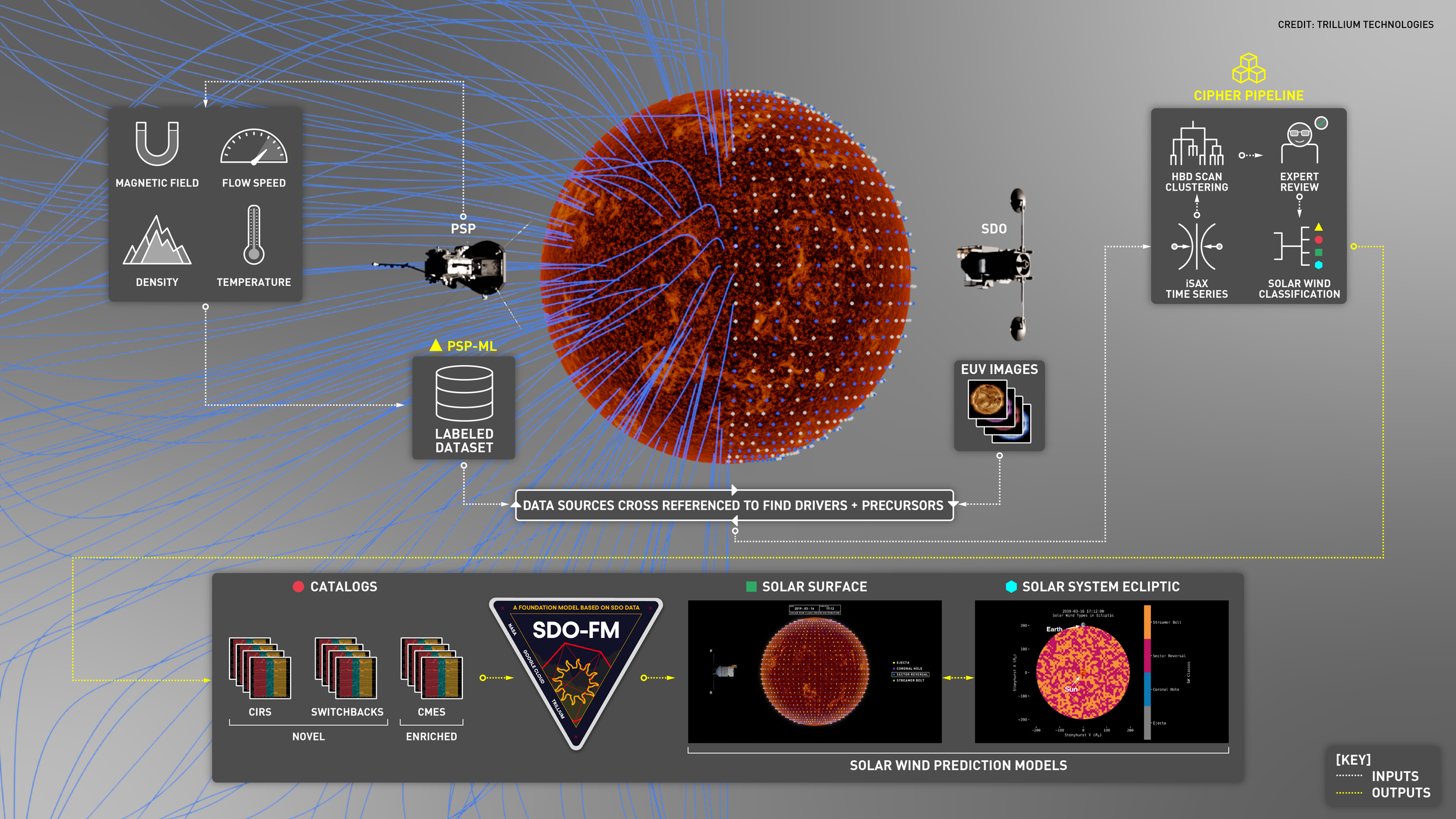
Meanwhile, the same architectures that power language systems like Gemini, Claude, and ChatGPT are now reshaping solar science. These foundation models, trained not on text but on terabytes of solar imagery and magnetograms are learning to interpret the Sun as a dynamic system. For the first time, the Decoding the Solar Wind team has used a solar foundation model (SDOFM) as the basis of a research product laying the groundwork for follow-up studies with NASA’s new SOTA Surya SDO Foundation model.
Quietly, another revolution has been taking place in the application of AI to challenges that for many years were supercomputing challenges. FDL’s PyRain and Coastal Twin pioneered surrogate modeling showing that AI could effectively replicate the capabilities of massive numerical models with a fraction of the resources and often multiple speed-ups enabling effective ensemble modeling. This year, we’ve partnered with NASA’s JPL to build the first ever AI digital twin of the Ionosphere, a potentially game changing contribution with applications in space, telecommunications and space traffic management.
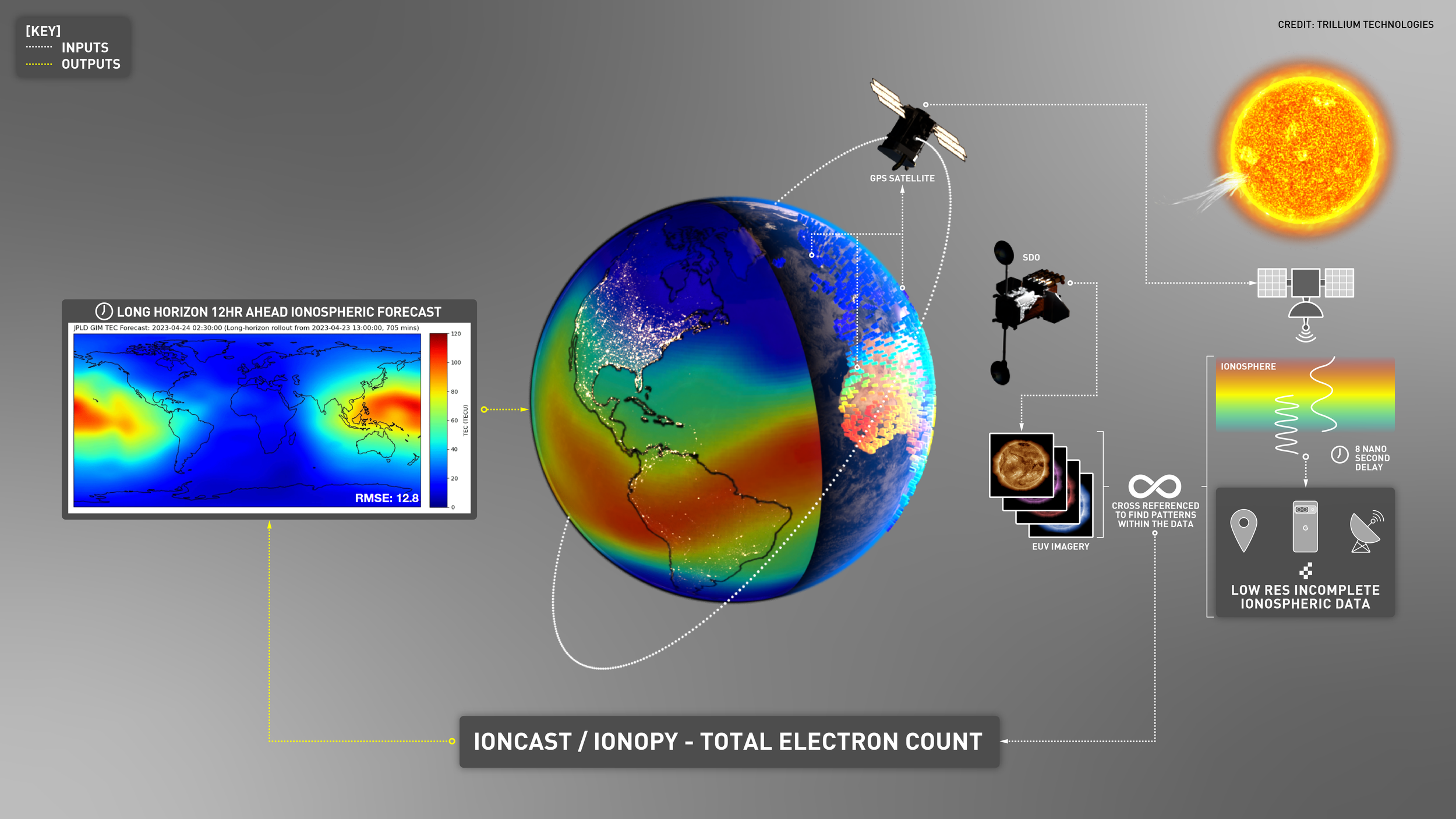
Together, these capabilities, hybrid observation, surrogate modeling and foundation models advance a new paradigm: Heliospheric Intelligence. No single institution has yet unified these components, but the frontier has shifted. We now glimpse the possibility of a cohesive framework, a decision intelligence layer that connects observatories, probes, and simulation engines. A prototype of this vision is explored by the Orchestrator team who show the power of these capabilities working together as a coherent “solar operating system.”
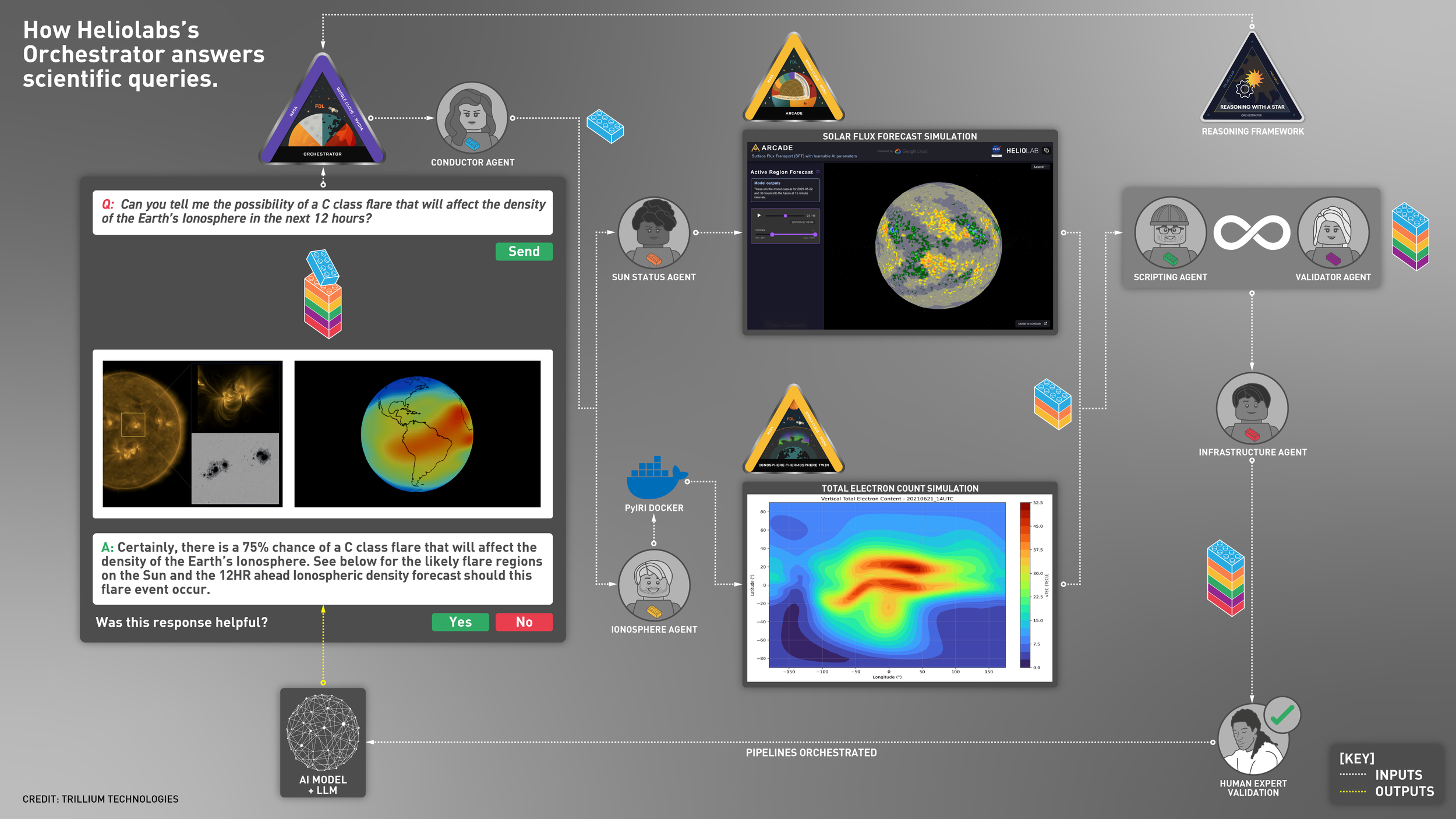
Orchestrator lays the groundwork for a system that can forecast solar storms with unprecedented fidelity, guide spacecraft through radiation hazards, warn astronauts in advance of flaring events or optimize power grid resilience back on Earth. It could even enable predictive dialogue between the Sun and Earth, where AI agents interpret heliophysical dynamics to scientists and mission operations in real time, revealing causal structure and ultimately the secrets of the solar dynamo.
Prediction alone, however, is not the endgame. The ultimate goal is to connect predictability with preparedness. AI is not merely a modeling instrument; it must align with the operational levers that protect astronauts, satellites, and infrastructure. The same intelligence that predicts a flare could inform spacecraft maneuvers, reorient communication networks, or trigger early alerts across electrical and telecommunication networks.
In an era often clouded by techno-pessimism, we see something brighter: a future where AI becomes an instrument of understanding, an intelligent collaborator in humanity’s effort to comprehend and coexist with the forces of our sun and unlock a future amongst the stars.
