Living inside a star: a moment of recognition
Tim Marshall’s book, ‘The Geography of the Future’ invites us to think about new territories of operations as humanity becomes a space-faring civilization. The invisible dynamic domains of particles, plasma, gravity and magnetism created through our relationship with the Sun absolutely fulfil this definition.
For many years, Dr. Madhulika Guhathakurta has helped reframe the simple but powerful idea.
We live inside a star.
This reframing sits at the heart of modern Heliophysics. And at the inaugural Global Space Awards in London, it received well-deserved recognition.
NASA scientist Dr. Madhulika Guhathakurta was a finalist in two categories at the Global Space Awards, highlighting her impact on how we study the Sun and how AI is coming of age for science.
Her leadership in championing the science of Heliophysics, and key roles in the creation of NASA’s Sun observing fleet (as well as multiple international collaborations) has helped enrich our understanding of our local star and its reach across the solar system.
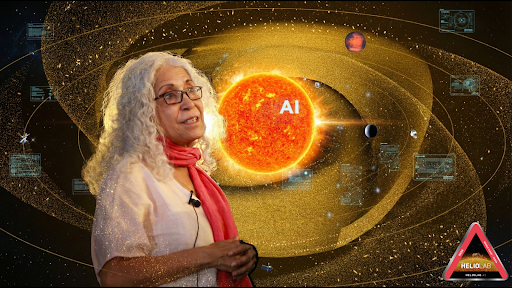
More recently she has brought another layer to that understanding, integrating AI into the ways we observe, model, and understand our solar environment, allowing us to have the beginnings of ‘sun to mud’ AI predictive capabilities for the first time.
Lika has been a driving force in the evolution of Frontier Development Lab’s Heliolab, delivered through Trillium’s partnership with industry collaborators Google Cloud and NVIDIA. She also helped shape the science framing of Surya, the first full-scale solar foundation model trained on petabytes of NASA SDO imagery in partnership with the NASA IMPACT team and IBM.
Surya offers a new way to learn from decades of solar data and unlocks fresh opportunities for scientific inquiry.
Congratulations, Lika. This recognition is richly deserved.
Explore the work behind these nominations: