
Uncovering the roots of solar storms with physics inspired AI
How can we move beyond black-box deep learning to create solar physics models at the root of space weather prediction, that are both physically consistent and rigorously aware of their own uncertainty?
This question sat at the heart of Heliolab researchers, who worked to bridge the gap between fundamental physics approaches and modern AI architectures.
Read the full blog below:
Forecasting Space Weather at its Source: A Gray-Box AI for Active Regions
What do the Carrington Event (1859), the New York Railroad Storm (1921), the Québec Blackout (1989), and the Halloween Storms (2003) have in common? This may sound like the start of a riddle, but these refer to space weather events that were so threatening to Earth’s electrical infrastructures that they required names for historical reference. So, what exactly is space weather, and how does it induce a downstream geomagnetic storm that can set telegraphs and power lines on fire, collapse power grids that warm our homes in winter, disrupt aviation and maritime communication, and down 40 newly launched Starlink satellites in a matter of days? Well, it all begins inside the Sun, where a knot of twisted, mangled magnetic field lines bursts through the surface in a powerful eruption that unleashes a deluge of energetic particles and radiation into the Solar System. When a solar storm reaches Earth, it can squeeze the invisible, protective magnetospheric bubble that surrounds us, allowing energetic particles to infiltrate through the North and South magnetic poles, where it distracts us with dazzling auroral displays while threatening critical Earth- and space-based technologies.
So, how do we attempt to mitigate such disasters? One way is to start at their source. Let me take you back to your introductory astronomy course, where you may have peered at the Sun through an H-Alpha filter in the lab to view dark spots moving across its surface. You learned that these are sunspots, handy observational features for estimating the rotation rate of the Sun.
However, sunspots also mark the sites of the strongest and most concentrated solar active regions (ARs), where the magnetic field becomes twisted or unstable. It is from ARs that space weather originates, whether in the form of a solar flare, a coronal mass ejection (CME), or a Solar Energetic Particle event (SEP). This means that knowing how ARs form and evolve on and beneath the solar surface, with high accuracy, is also knowing how to forecast downstream flaring events and take protective action before a potential disaster strikes.
For decades, many resources have been devoted by academic, government, and corporate entities to forecast space weather through state-of-the-art (SOTA) modeling of the solar, space, and geophysical processes involved. The leading heliophysics simulations that model AR dynamics and evolution are known as Surface Flux Transport (SFT) models, offering accurate predictions of where the magnetic flux will be on the solar surface over timescales of day to months; however, not when, as they are currently unable to estimate the emergence of new flux from the solar interior. This presents a major hurdle in flare forecasting due to the risk posed to the health of astronauts conducting deep-space walks, as they would need notice on the order of minutes to hours to seek shelter from the storm.
As you might imagine, these shortcomings in space weather forecasting left our FDL Heliolab 2025 Team ARCADE with the perfect challenge, where we set out to discover:
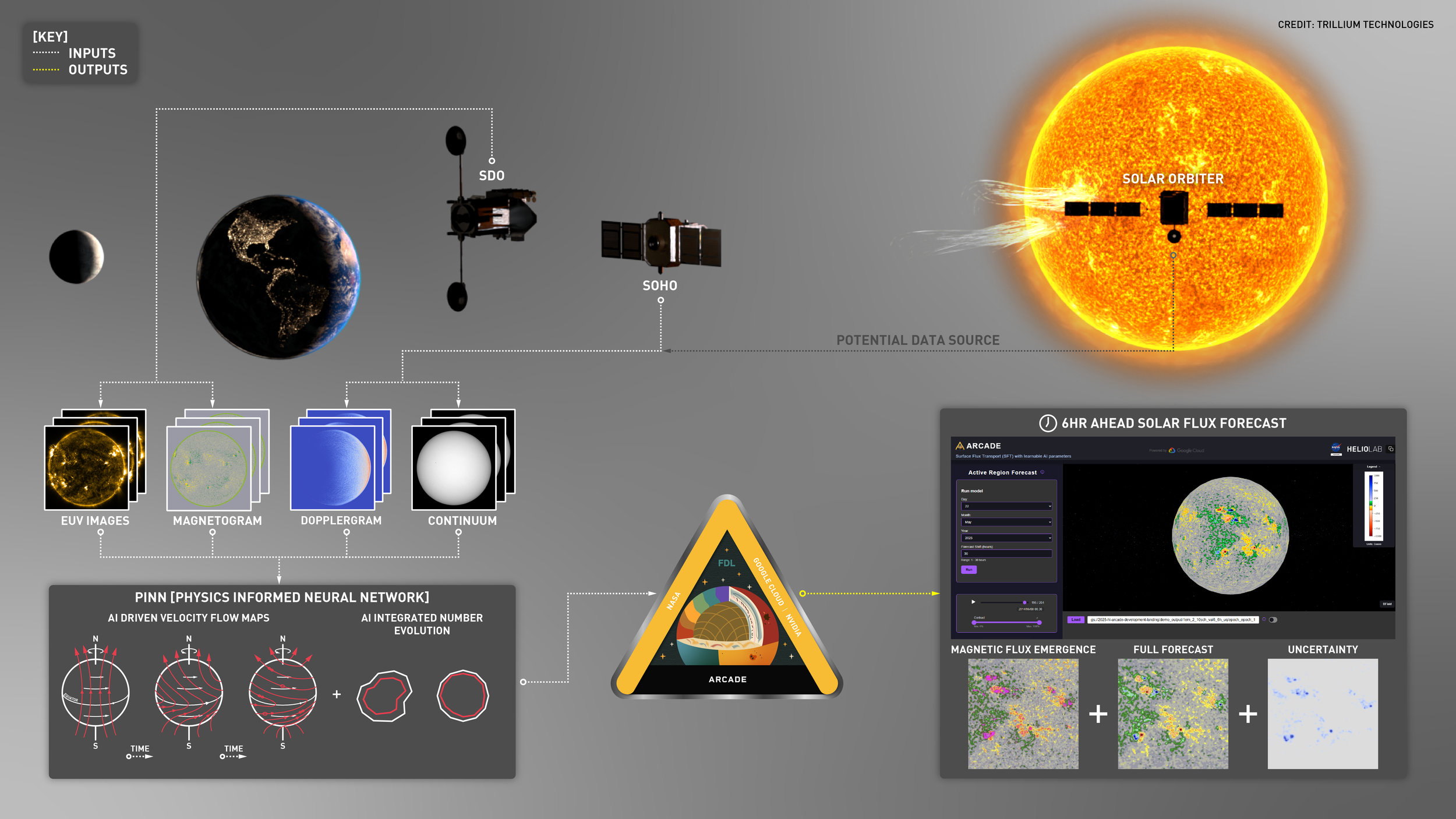
What would happen if we unleashed the powers of the AI ‘black box’ inside the ‘white box’ of known physical constraints to create a novel ‘gray box’ solution of physics-informed, data-driven models?
Would this hybrid approach allow us to accurately and reliably generate short-term, high-resolution forecasts of the spatiotemporal evolution of solar surface magnetic flux, hours in advance, including predictions of new flux emergence, a capability that remains an open challenge in the community?
I’m happy to report on behalf of ARCADE that the answer turned out to be ‘yes.’ You will soon be able to see this for yourself with our interactive user interface for SFT forecasting developed over the summer.
To accomplish this ambitious goal, we took inspiration from a cutting-edge Earth climate model known as ClimODE, which uses neural networks to learn how a physical system evolves in time, embeds that learning inside differential equations, and combines it with known physics to produce predictions that are more accurate, stable, and physically realistic than either physics simulations or deep learning models alone. Within this framework, we trained and validated our model against the SOTA SFT simulations from the Advective Flux Transport (AFT) model — which also incorporates real magnetic images of the Sun in the form of magnetograms from the Solar Dynamics Observatory (SDO) — to learn all the physical parameters governing 2-D magnetic flux transport on the surface of the Sun. In an ancillary component of our main model, we again used AI to learn directly from thousands of input SDO magnetograms, the refined parameters for longitudinal and latitudinal surface flow velocities caused by differential rotation and meridional flow, which could then be 'plugged in' to the main model to generate the most accurate and reliable forecasts of surface magnetic flux evolution and emergence.
Despite the initial success of our model, we’re refining its machinery and stretching its scope to ask additional questions such as: Can our fusion of data-driven AI and physics-based flux transport detect imprints of surface magnetic-field evolution even in non-magnetic data? The early answer appears to be ‘yes.’ Preliminary training on SDO visible-light photospheric-intensity maps and extreme-ultraviolet images of chromospheric and coronal structures surprisingly reveals that the model can recover solar differential rotation and meridional flow, materially improving our forecasts beyond magnetogram-only training.
With that said, please stay tuned for more updates from our gray-box model that learns the Sun’s rules, not just its rhythms - bringing earlier, more reliable warnings to protect our power grids, satellites, and the lives of future Artemis astronaut crews.
- Written by Nina Bonaventura, FDL Heliolab researcher
Integrating fundamental physics equations with deep learning, ARCADE developed a hybrid, uncertainty-aware framework that delivers interpretable and highly reliable forecasts of active region evolution.
This breakthrough provides an early-warning system for hazardous solar events, bridging the gap between traditional physics and AI to enable more accurate space-weather alerts in advance.
