
Reading the solar wind before it reaches us
The solar wind, a constant stream of charged particles from the Sun, shapes the space environment around Earth and drives events that can damage satellites and power grids. But predicting its behaviour remains extremely hard. No single instrument sees everything.
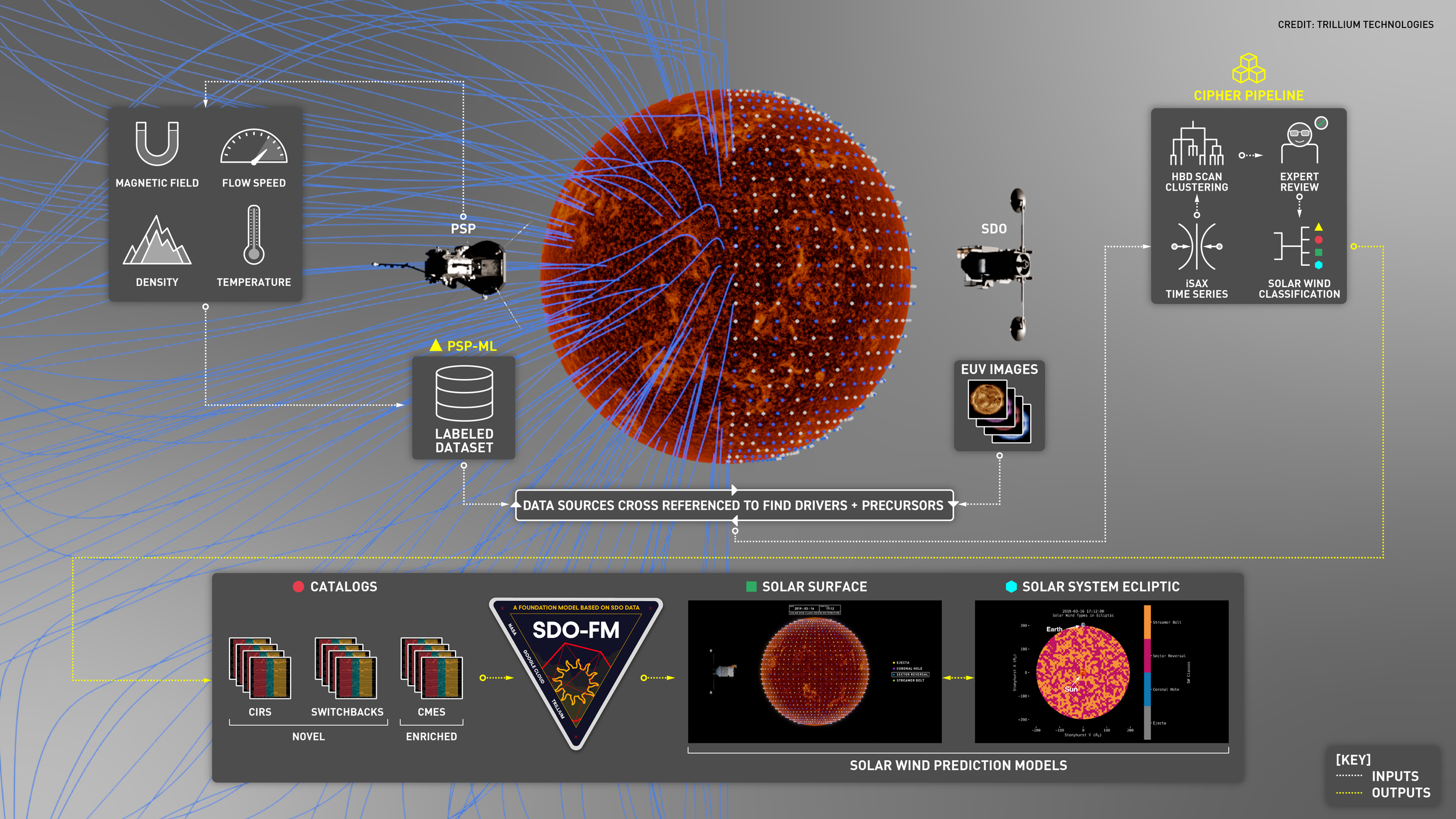
At FDL this year, researchers built an AI system designed to do something new: connect solar imagery with in-situ plasma measurements to reconstruct and classify solar-wind states.
Read the full blog below:
Can AI Decode the Solar Wind Before It Reaches Us?
What if we could understand the Sun’s behavior fast enough to protect the technologies we rely on every day? During this year’s Frontier Development Lab (FDL), my team set out to explore exactly that question — and we discovered that artificial intelligence may hold the key to reading the solar wind before it reaches Earth.
What is carried by the solar wind?
The solar wind — a constant stream of charged particles flowing from the Sun — shapes the entire heliosphere and drives some of the most disruptive space-weather events. These disturbances can damage satellites, interrupt communications, and even affect power grids.
We have decades of observations from spacecraft like NASA’s Parker Solar Probe and the Solar Dynamics Observatory, but the challenge is scale: the data is massive, complex, and no single instrument sees the full picture. To predict the solar wind more accurately, we need a way to fuse all these perspectives into something coherent and actionable.
A new AI lens on the Sun
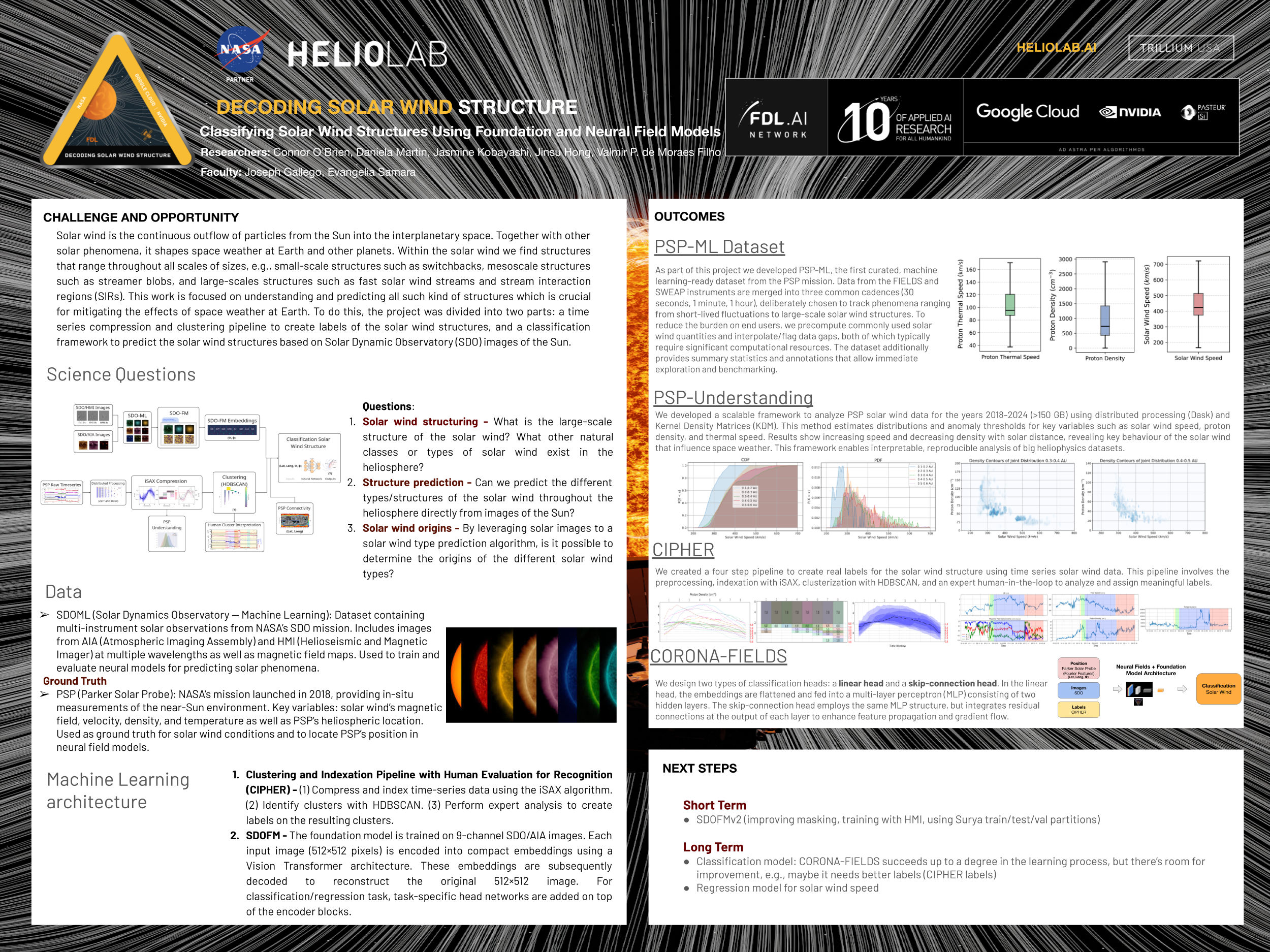
Our approach was to build an AI system capable of learning from this enormous, diverse dataset — from high-cadence solar imagery to in-situ plasma measurements — and uncover patterns that humans and traditional models cannot easily see.
We developed new large-scale pipelines to handle terabytes of solar observations, and we trained machine-learning models that can capture the subtle relationships between the Sun’s evolving magnetic structures and the solar-wind conditions measured millions of kilometers away. By teaching the AI to “connect” remote-sensing views of the Sun with the solar wind actually sampled by spacecraft, we created a model that can infer solar-wind properties even in regions where direct measurements don’t exist.
The result? Our system can reconstruct and classify solar-wind states with promising accuracy, offering a foundation for more reliable predictions in the future.
Why this matters — and what comes next
Better space-weather forecasts mean better protection for satellites, navigation systems, astronauts, and power grids on Earth. But beyond immediate applications, this work highlights something bigger: the potential for AI to act as a bridge between different kinds of scientific data and help us understand the Sun as an interconnected system.
There is so much left to learn — and we’re only just beginning to unlock what AI can reveal about our star.
- Written by Daniela Martin, FDL Heliolab researcher
Early results show strong promise, providing a foundation for more reliable space-weather forecasting.
Impact: Better warnings for satellites, astronauts, navigation systems, and infrastructure on Earth, and a major step toward treating the Sun as an interconnected system rather than fragmented datasets.
