
Can we forecast the motion of electrons through our ionosphere?
Geomagnetic storms threaten the infrastructure we rely on, yet our ability to forecast them hasn’t kept pace with the complexity of our systems.
This year at Heliolab, researchers tackled a core question: can we predict the movement of electrons through the ionosphere hours in advance?
Read the full blog below:
Can we forecast the motion of electrons through our ionosphere?
On a Tuesday night in November of 1965, over 30 million people across Canada and the US were plunged into darkness. A surge of electrons flowing across our ionosphere caused the mighty power grid of New York City to fail for 13 hours. Today, we have developed weather models to predict the onslaught of a winter storm, but we have little power to foresee the strength of a geomagnetic storm such as that which affected those 30 million people on a cold day in 1965. But what if we could forecast the movement of electrons through our ionosphere with the same fidelity that we expect of modern-day weather models? This is the problem that my team and I confronted together during our time at FDL.
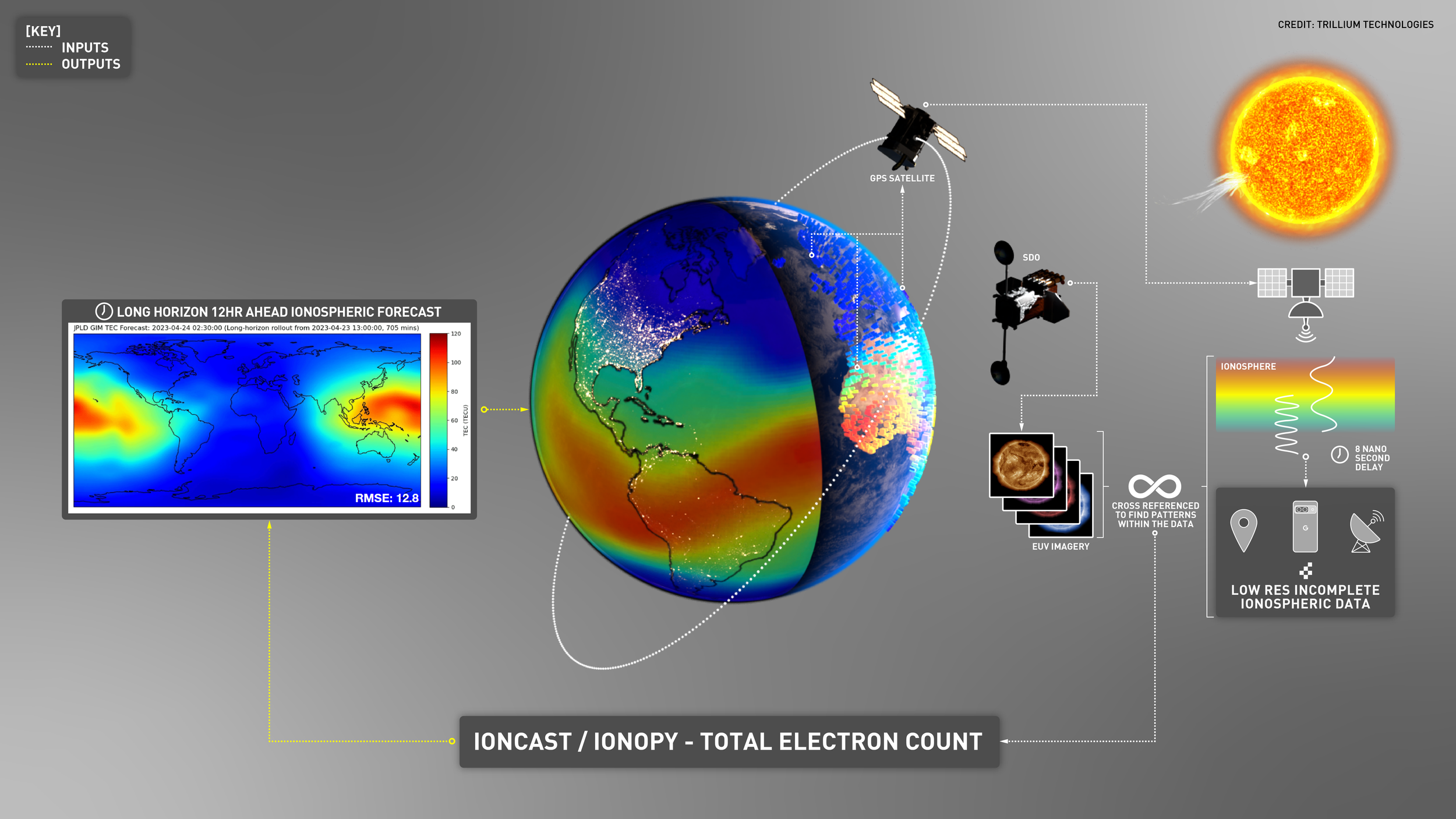
When researchers examine the ionosphere, the critical component they attempt to understand is the Total Electron Content (TEC), or the integral of the electron density from ground up to a given height in the ionosphere. This simplifies the problem of capturing the dynamics across a 1,200-mile (1,900 km) tall space to a 2D grid of TEC. To prevent the power grid failure that was experienced 60 years ago, our chief objective was to predict global TEC at a future state, given our current one.
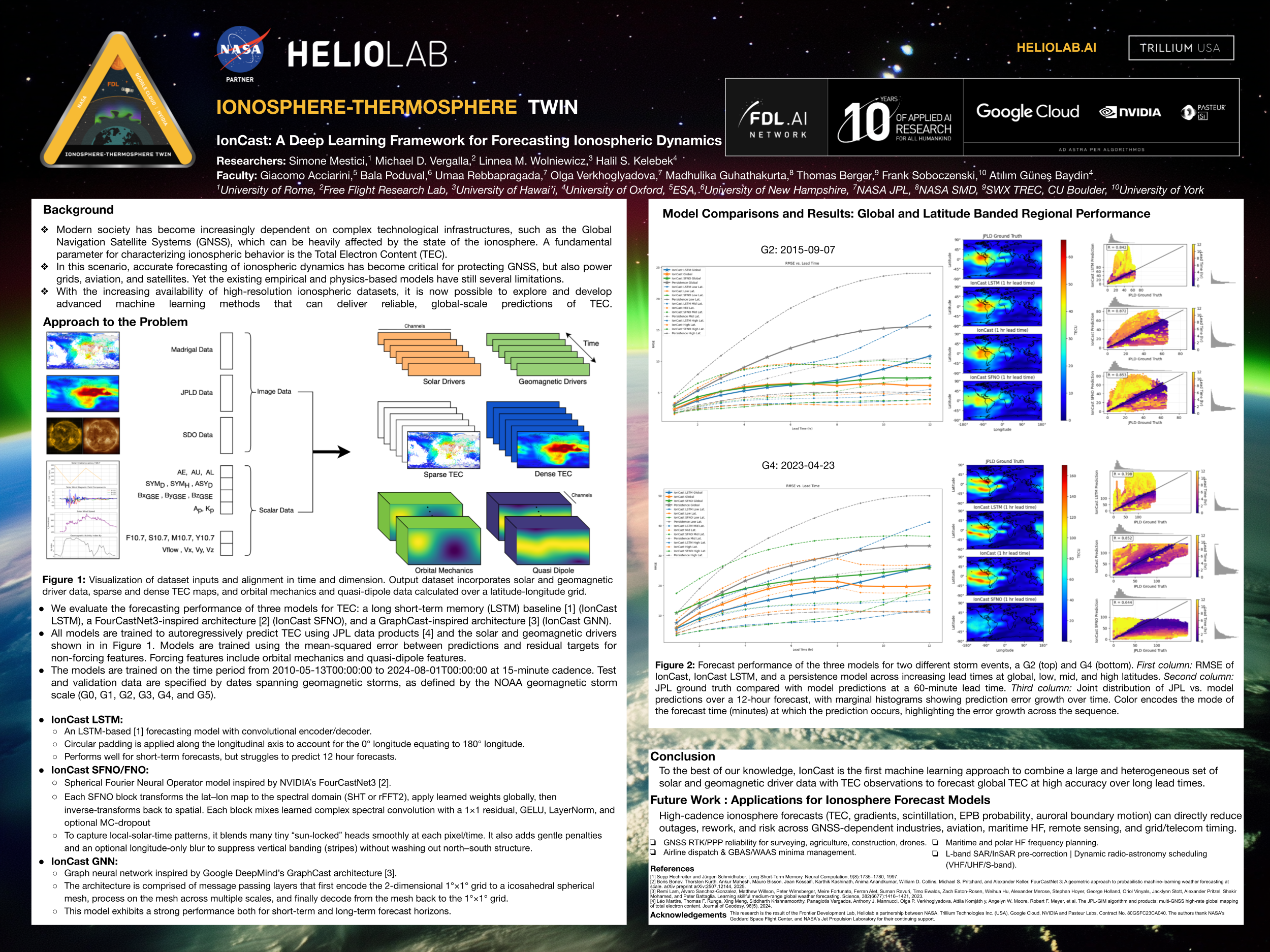
To do this, we combined solar and geomagnetic driver data, along with an existing database of TEC maps produced by NASA, as input to a suite of machine learning models inspired by the state-of-the-art in weather modelling. These models, named IonCast, included a baseline LSTM architecture along with a graph-based model inspired by Google DeepMind's GraphCast, and a spherical Fourier neural operator model motivated by NVIDIA's FourCastNet3. The IonCast models take in a context of driver and TEC map data to autoregressively predict the state of the ionosphere into the future, much as large language models predict the most correct response given input from a user. Our models achieve accurate forecast performance over lead times of up to 12 hours.
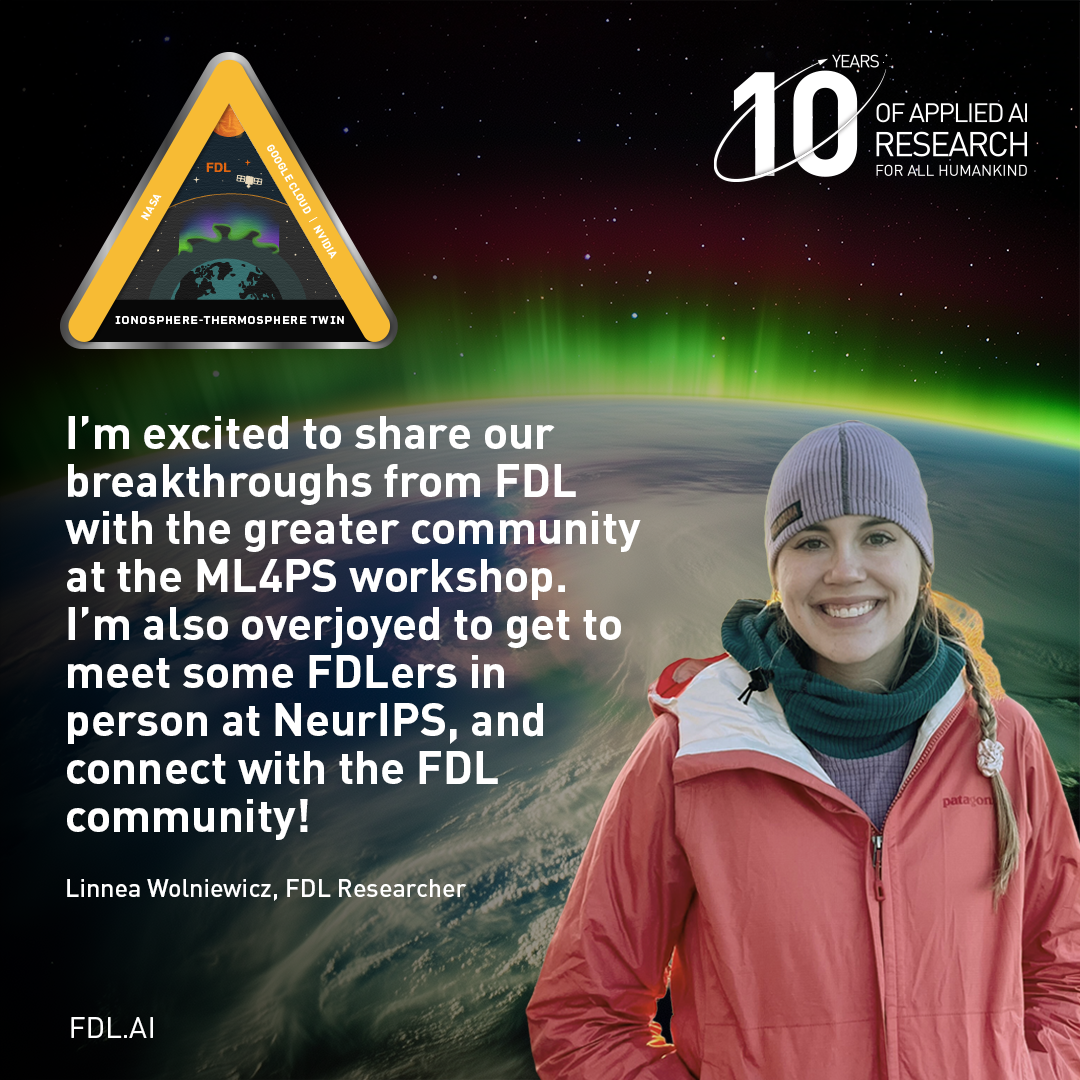
This is just the beginning of our journey to forecast the motion of electrons through our ionosphere and how they influence the lives of humans beneath it. We are presenting our work as poster presentations at the Machine Learning for the Physical Sciences workshop at NeurIPS 2025 and AGU 2025, and some of our papers have already been released on the arXiv (IonCast paper, dataset paper, sparse TEC prediction paper). We hope to next improve our models by producing probabilistic predictions and directly translating our TEC forecasts to FAA warnings to improve aircraft safety.
We hope that even as the technological reliance of humanity on a quiet sun increases, our ability to foresee the movement of electrons across our ionosphere will prevent the surge that thrust so many people into darkness in 1965 from happening again.
- Written by Linnea Wolniewicz, FDL Heliolab researcher
IonCast delivers accurate global TEC forecasts up to 12 hours ahead, a critical step toward operational systems that can feed directly into aviation alerts and space-weather warnings. Stronger forecasts, safer skies, and fewer communities vulnerable to the kind of geomagnetic surges that once plunged millions into darkness.
