
FOXES - mapping solar flares using only EUV images
Solar flares are powerful bursts of radiation that can disrupt satellites, GPS, communications, and threaten astronaut safety. Yet current flare catalogs contain gaps and inaccuracies, especially when multiple flares overlap.
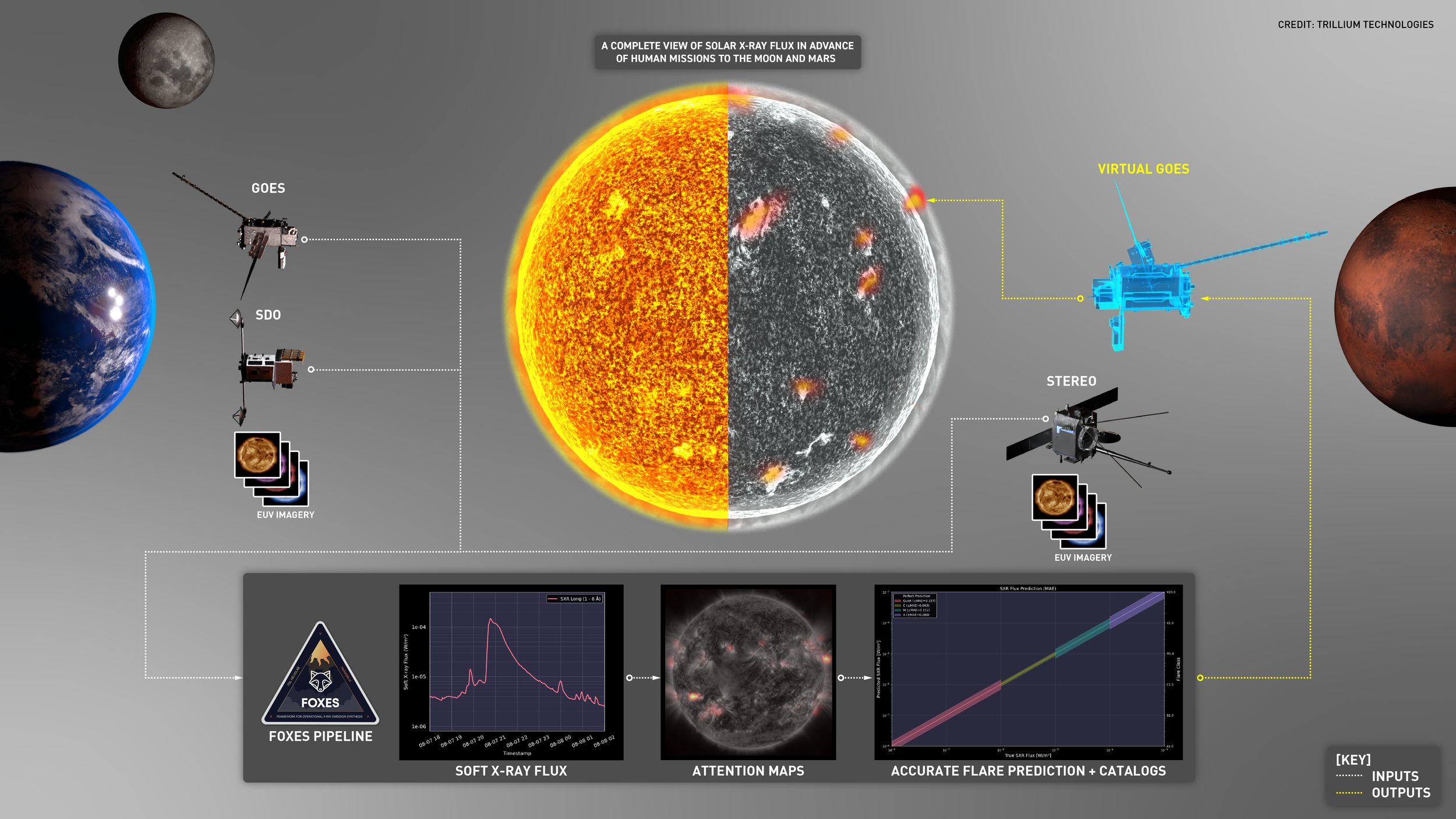
This year at Heliolab, researchers explored an audacious idea: Can we estimate a flare’s soft X-ray flux using only EUV images?
Read the full blog below:
Learning Through the Eyes of FOXES: Using Vision Transformers to Dissect the Sun
If you had to pick one thing that you absolutely couldn’t live without, what would it be? Your morning coffee? Your phone? Maybe even your niche collection of antique pencil sharpeners (no judgment here)? For the most part, those all seem pretty reasonable, but technically I’d say there is a correct answer: the Sun.
The Sun is our lifeline here on Earth, providing us with all the energy we need to survive. Without it, we simply wouldn’t exist. But much like your cat, who offers love and affection 99% of the time, there’s always a small chance that you will end up with a handful of claws after going in for a belly rub. Solar flares are like the claws of our cat, the Sun (what would that make Earth, a yarn ball?). You can think of them as large outbursts of electromagnetic radiation (visible light, X-rays, etc.), which can create serious disruptions to satellites, GPS, and power grids… something that may sound especially worrisome for those of you who picked “phone” earlier.
Because of these potential impacts, understanding and predicting when flares may occur has become essential for protecting our technological infrastructure and many of the systems we depend on each day. One of the necessary ingredients for making such forecasts is an accurate flare catalog, with a detailed history of when, where, and how strong each flare was. The better these records, the easier it is to train models to predict these events in the future. Unfortunately, many existing catalogs suffer from data gaps, inaccurate flare locations, and even misclassified strengths, especially when multiple flares occur at once. Complicating matters further, our current ability to monitor solar activity outside of Earth’s vantage point is quite limited. Sadly, we don’t have any soft X-ray instruments (which are critical for measuring flare strength) positioned outside the Sun-Earth line. This makes it especially challenging to protect astronauts on future missions to Mars and the outer Solar System.
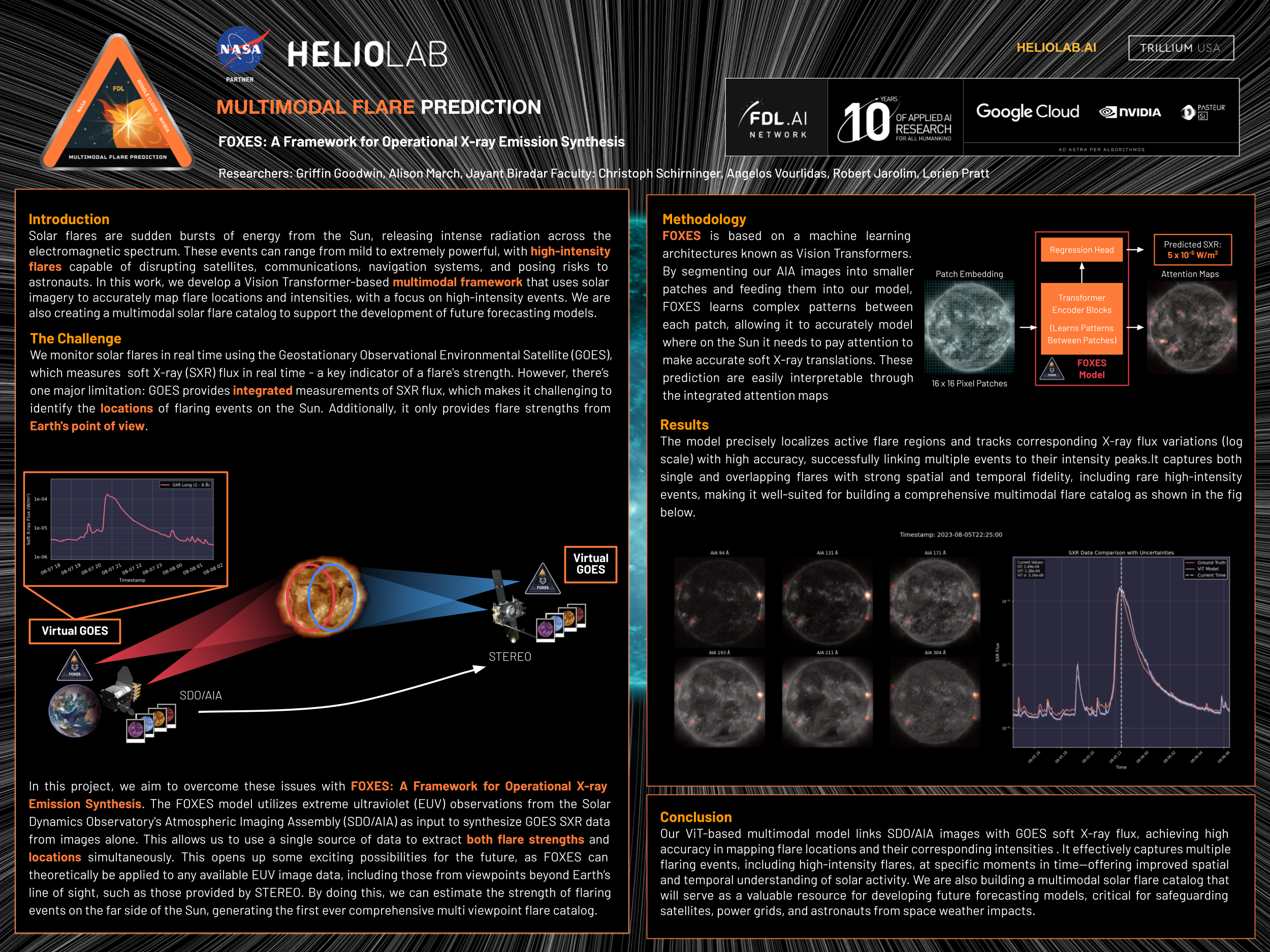
To address these issues, our team, as part of FDL’s Heliolab, developed FOXES: A Framework for Operational X-ray Emission Synthesis. Our goal was to answer a deceptively simple question: “Is it possible to determine a flare’s soft X-ray flux from extreme ultraviolet (EUV) images alone?”
If we could learn this mapping, we would not only be able to measure the strength of flares when soft X-ray data isn’t available, but we would then be able to utilize the newly added spatial information to further refine the locations and strengths of flares within current and future catalogs.
So, can it be done? The short answer: yes. Using a state-of-the-art machine learning architecture known as vision transformers, FOXES successfully generated the mapping between EUV images and soft X-ray data. You can think of vision transformers as analogous to many modern large language models such as ChatGPT, Claude, and Gemini. Except, instead of processing language, FOXES segments the EUV images into patches that act like “words” within the broader context of the “sentence” that makes up our image.
What makes FOXES especially impressive is that its translations were not only accurate but physically interpretable, with the model focusing on relevant solar features when making its predictions. We were even able to successfully extract individual flare strengths for simultaneously occurring events, a problem that has long challenged the field. With further development, FOXES could become a significant step forward for the space weather community.
Finally, given the success of this project, we now have the exciting possibility of measuring flare strengths on the far-side of the Sun. Since FOXES was trained on EUV data, we can, in theory, apply the model to any of the multitude of EUV instruments found beyond the Sun-Earth line. This would ultimately expand our observational reach and help us to build a more complete picture of solar activity. Wow! Continuous monitoring of our cat from multiple angles, eliminating any chance of being scratched? That’s something pet owners like me can only dream of.
There is still much more to come! Stay tuned!
- Written by Griffin Goodwin, FDL Heliolab researcher

EUV instruments exist beyond the Sun–Earth line, FOXES could eventually measure flare strengths from multiple viewpoints, giving scientists visibility we’ve never had before. Better flare catalogs, stronger forecasting pipelines, and a safer technological infrastructure as human activity extends deeper into space.
