
Engineering Assurance
for Machine Intelligence
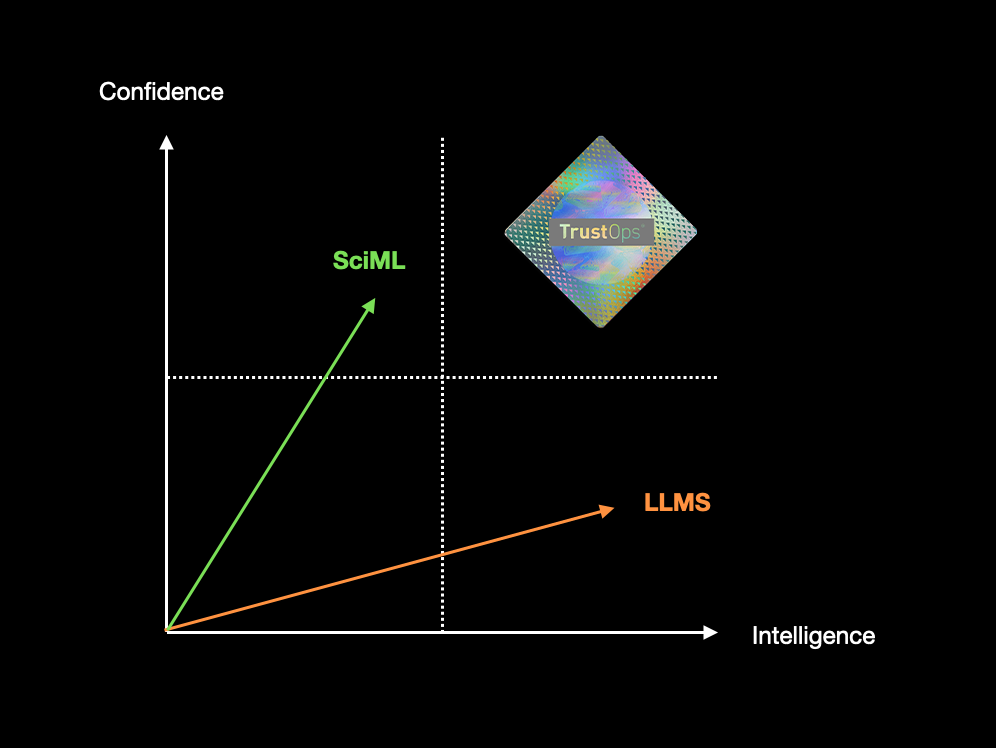
High-stakes SciML needs a new kind of trust assurance.
TrustOps is an engineering paradigm for AI that ensures high-confidence operational decisions, leveraging dynamic orchestration and mathematically grounded evidence.
Decision Assurance
Machine learning enables human-machine reasoning based on real phenomena like solar flares or hurricane formation. However, for mission-critical environments in space, aeronautics and human health, these capabilities remain mid-TRL without bounded confidence.
TrustOps reframes the question, running traditional computer science formalization backwards:
"What evidence stack is required to reach the trust threshold needed for this operational decision?"
How TrustOps works
TrustOps is an engineering discipline concerned with constructing, orchestrating, and continuously validating evidence pathways that transform machine intelligence into mission-assurable operational decisions.
Rather than attempting to bolt safety onto an AI system post-hoc, TrustOps treats downstream confidence as an emergent property of an orchestrated sequence of independently falsifiable processes. True operational trust emerges only when multiple independent verification methods actively attempt to invalidate the same claim as well as one another. This capability is built during the engineering phase.
TrustOps as Process and Architecture
TrustOps can be thought of as both a process and an architecture. It is an engineering process methodology for developing, testing, integrating, and maturing evidence-bearing machine-intelligence capabilities. It is also a dynamic assurance architecture for evaluating whether the evidence required for a particular operational decision continues to hold at runtime.
Together, these two dimensions form an emerging engineering framework that links demonstrated performance, assurance confidence, operational consequence, and permitted authority.
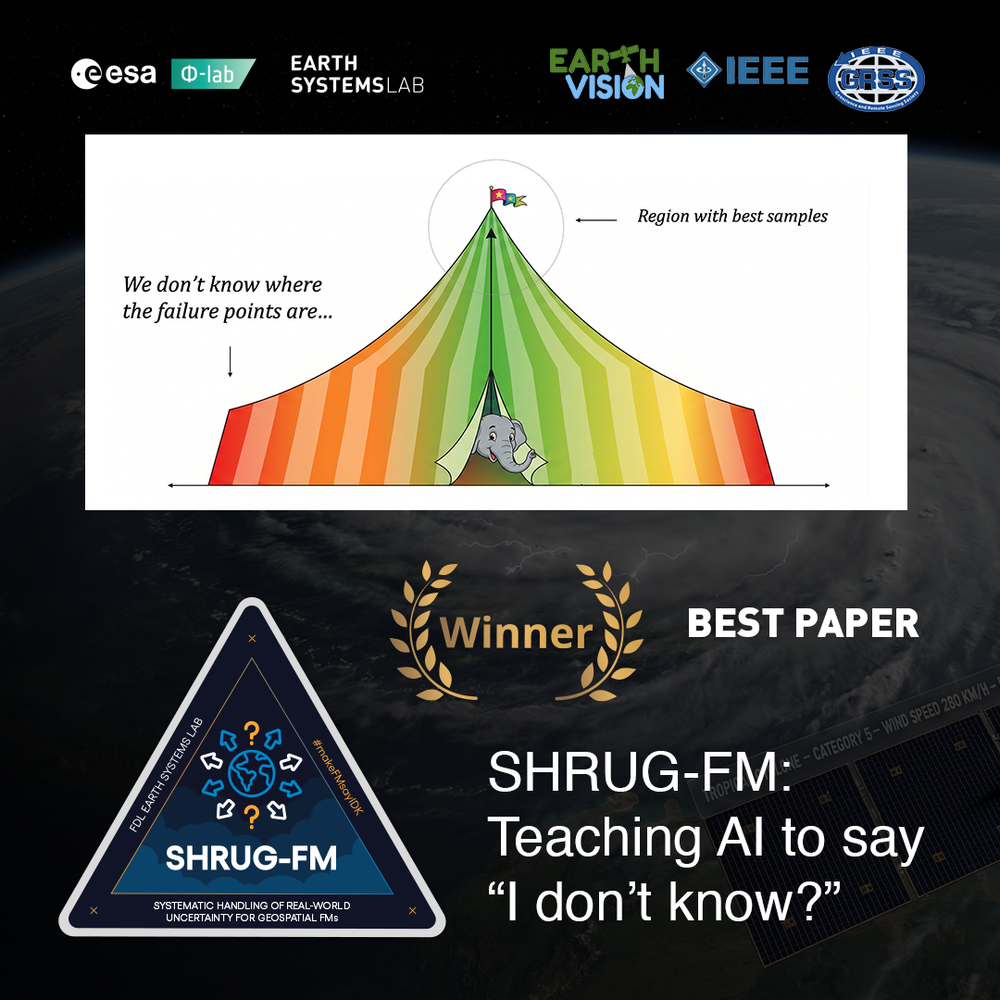
Trillium has been leading the industry in advanced epistemics, with breakthroughs such as SHRUG-FM - which demonstrated how we can make an AI say “I don’t know” (Winner, Best Paper at CVPR Earth Vision 20026) Read more here
Scientific and Aerospace Foundations
The TrustOps discipline bridges contemporary machine learning with decades of rigorous, scientific and aerospace safety frameworks, e.g.
Falsification (Hunting for Failure): Actively challenging AI models with adversarial inputs to break the system's safety hypothesis before deployment.
Hoare / Dijkstra Formal Verification (Mathematical Proof): Reversing classic computer science logic to calculate the weakest preconditions required to guarantee a safe postcondition outcome from a machine learning model.
NASA Systems Engineering (Systems Integration): Managing complex trade-offs, system requirement analyses, and continuous verification and validation (V-model) architectures at runtime.
MLTRL (Engineering Rigor): Ensuring high-TRL best practice by establishing switchback simplification steps on the journey to an operational system.
How Dynamic Orchestration Works
When a machine learning model generates an operational recommendation, any TrustOps system reviews the preconditions that must be satisfied for the outcome to be verified as safe.
If the confidence trajectory falls within the certified safe envelope, any decision is assured. If any gate fails to meet the threshold, the system initiates real-time refinement loops, engages deterministic circuit breakers to block execution, or safely escalates the decision to an expert human reviewer.
CREDIT: Lavin et al
Technology readiness levels for machine learning systems