
Rebuilding tropical cyclones in 3D
Tropical cyclones are among the most destructive events on Earth, yet our view inside them is still remarkably limited. Geostationary satellites watch from above every few minutes, but only in 2D. CloudSat may catch a storm once or twice. Aircraft fly-throughs are rare.
That leaves a critical gap: we rarely see the internal structure of a cyclone as it evolves, especially during the earliest hints of rapid intensification.
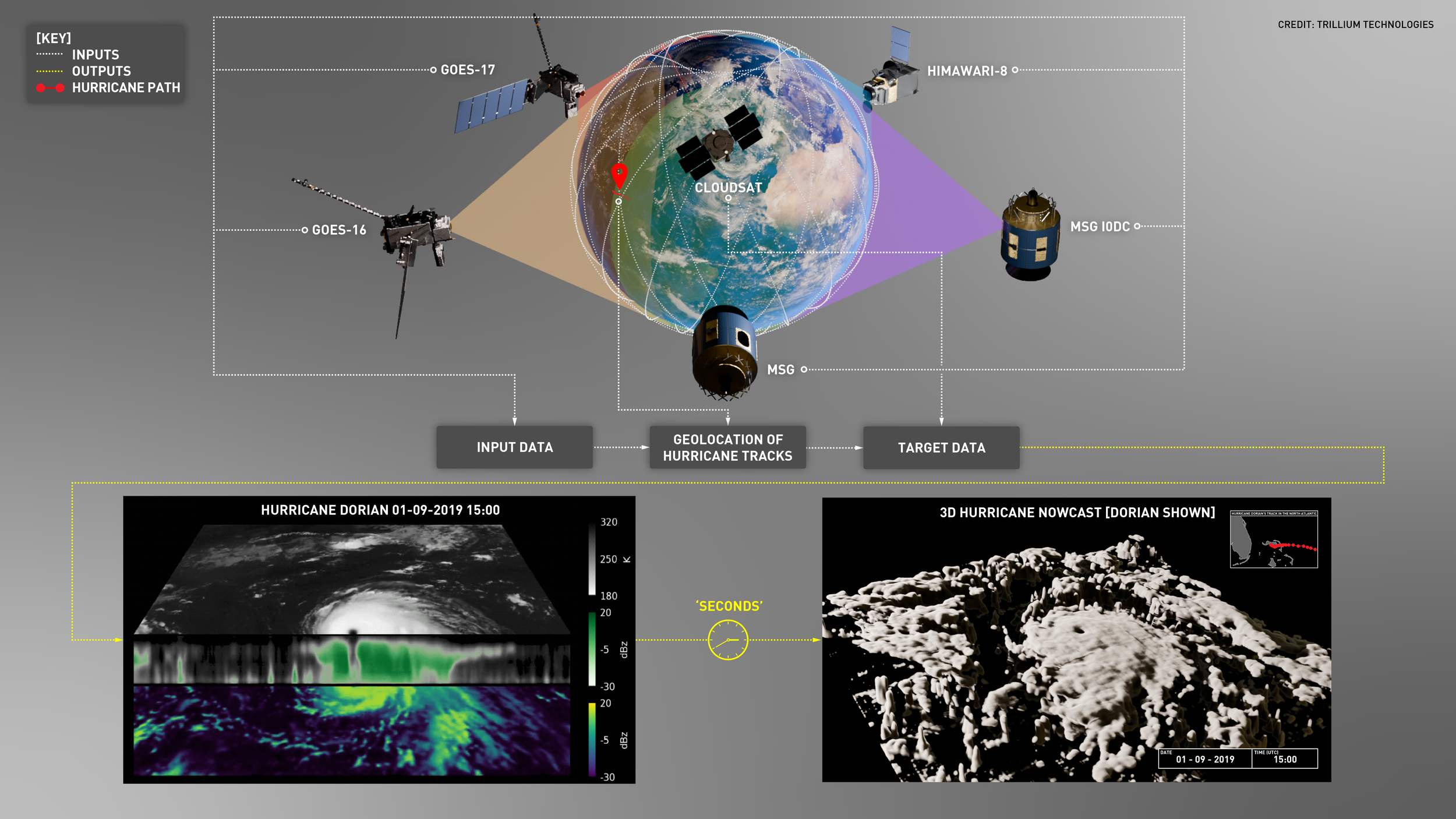
This year at the Earth Systems Lab, researchers asked a bold question: can we reconstruct a cyclone in 3D, continuously, using the data we already have?
Read the full blog below:
An ‘X-ray’ for tropical cyclones using machine learning
Tropical cyclones such as hurricane Melissa are some of the planet’s costliest weather events. However, they are to observe and predict accurately. Our team for the FDL Earth System Lab this year took on the challenge to create a model that would help continuous and global monitoring of these devastating storms in three dimensions.
Tropical cyclones are currently observed using the cloudprofiling satellite CloudSat but that only sees cyclones once, maybe twice in their life cycle. More targeted observations come from fly-throughs undertaken by national weather services. Many of the most intense storms however undergo a rapid intensification stage, before they are necessarily on the radar of national weather services. Recent research shows that there might be warning signs that cyclones can undergo rapid intensification in the internal physics of the storm. To make use of these warning signs, we need continuous monitoring of these devastating storms though.
In our team, we focused on leveraging the data that we do have on tropical cyclones to the best of our ability to create 3D models of storms and their internal physics. We used geostationary imagery which sees the clouds from above every 10-15 minutes. Together with a limited number of vertical profiles of clouds and the location and time of tropical cyclones, we can now reconstruct storms in 3D at any time of day. They make for some fascinating visuals (check out our post on hurricane Melissa) but also helps to understand the intensification in storms.
Our model, we hope, will be immensely useful to forecasters and the scientific community (as well as being inspiring to look at) who can use the 3D structure to better understand when and where a storm might intensify. Using the high frequency of geostationary imagery, we are hugely increasing the data available for cyclones, allowing researchers and forecasters to develop better early warning systems and protect people on the ground.
— Shirin Ermis, FDL Earth Systems Lab researcher
The team’s work:
Successfully developed a sensor agnostic ML pipeline that reconstructs the complete 3D internal structure and microphysical properties of tropical cyclones using only 2D geostationary satellite imagery.
Predict key variables critical for understanding intensification, including radar reflectivity, ice water content, and effective droplet radius, providing a continuous view of a storm's dynamics.
Pipeline was validated on Hurricane Dorian, where it successfully reconstructed the storm's 3D evolution during its rapid intensification phase - a period for which direct observations were previously unavailable.
Produced a novel 3D dataset of tropical cyclones.
The result is a model that can generate 3D reconstructions of storms at any time of day, revealing structures that are crucial for understanding intensification. A clearer view of some of the world’s most dangerous storms, helping forecasters build earlier warning systems and protecting people on the ground.