
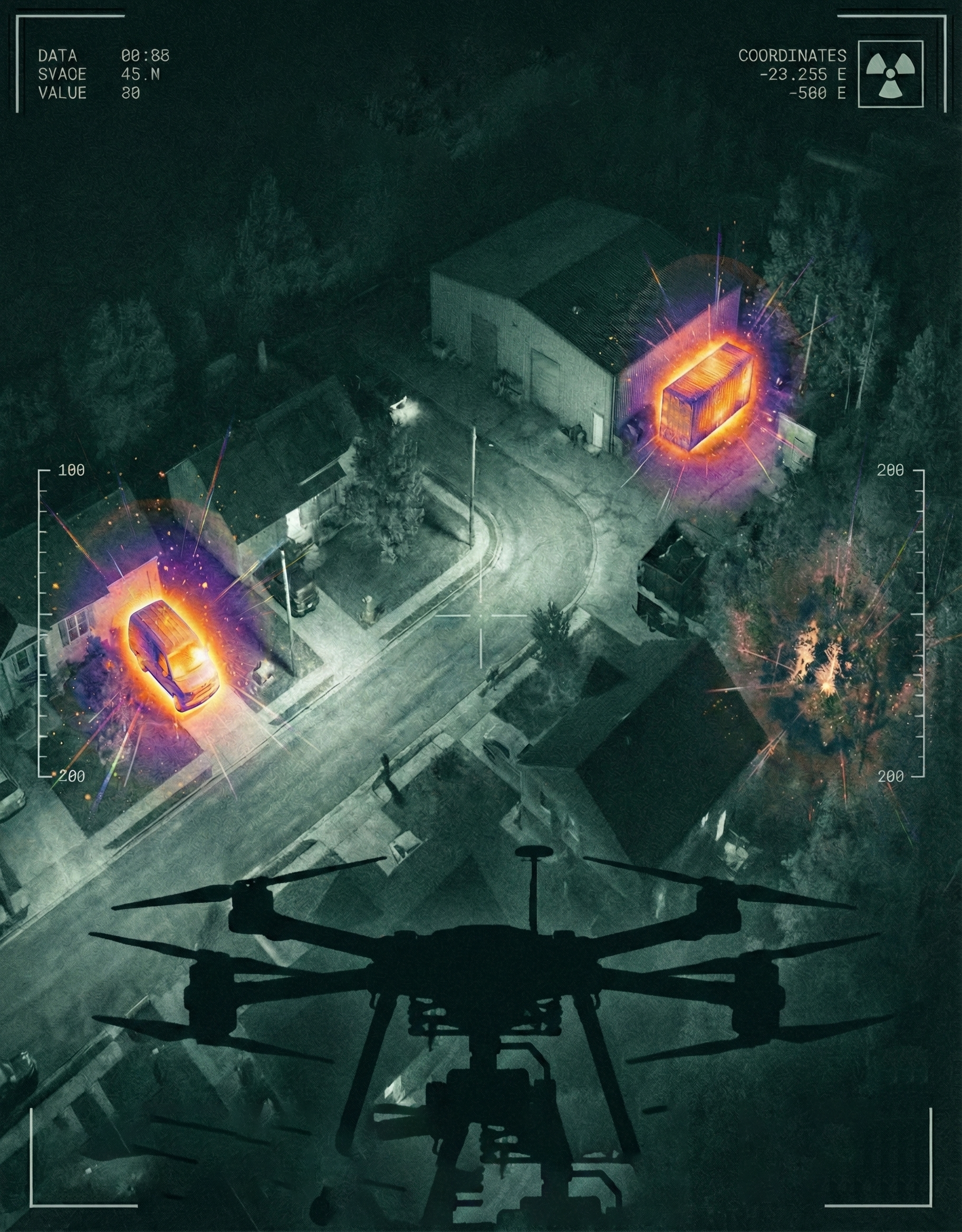
AI for national security, accelerated science and energy dominance: the DOE Pilot with the Frontier Development Lab.

In 2022, the DOE’s AITO office sponsored 7 targeted AI challenges with the Frontier Development Lab (FDL.ai) in partnership with Google Cloud and NVIDIA and other leaders in commercial AI.
The pilot demonstrated that interdisciplinary teams could deliver SOTA AI outcomes on parity with the world’s leading AI labs over accelerated timescales and significantly reduced cost – delivering critical new capabilities for national priorities with an unparalleled strike-rate.

Grid Modernization
Gridworld: a digital twin of Texas during a national emergency capable of determining power-grid vulnerabilities.
-
Showed the potential of ML orchestrated data driven systems twinning for resilience assessment and hardening infrastructure. Gridworld validated that AI can ingest climate models and grid topology to predict failure points before they break.
Radiation Detection for increased security
RADBOT: A drone-based radiation detection system that unlocks urban radiation detection from the air.
-
Unlocked capability to deploy radiation detection systems on drones for the first time. (Previous systems required trucks.)
CO2 Sequestration
SAIF: ML controlled super-critical CO2 injection methodology to reduce induced seismicity.
-
SAIF was integrated into carbon sequestration software to enhance the safety of CO2 Sequestration. This architecture is transferable to other "subsurface" Genesis challenges, such as Critical Mineral discovery or Geothermal reservoir modeling.
Advanced Dry Cooler Engineering (energy dominance)
SOLAIR: Leaps in efficiency gains and cost reduction for concentrated solar dry cooler technology. (Nature Paper.)
-
Demonstrated early promise for SciML techniques in radically improving engineering efficiency and cost.
Groundwater transport modeling (Security)
MULTISCALE TWIN: Advanced HPC-scale simulation of groundwater transport using ML surrogates, crucial for managing brownfield sites, nuclear waste storage and other sources of freshwater pollution.
-
Rapid simulation – normally requiring supercomputers – of groundwater transport nationwide based on multiple future climate scenarios for 100 years.
Wildfire burn assessment
FireCLR: Drone / satellite post-wildfire fire burnscar assessment that can determine burn intensity.
-
Capability open sourced for the community.
Automating Science Workflows
Retriever: ML enabled decision intelligence tool chain for determining best practice in lowering the cost of H2 production.
-
Tooling for process innovation. (Mid TRL.) This toolbox can be applied to any national process requiring acceleration and directly aligned with the Genesis goal of "automating research workflows.
Case Study: FDL’s success with SAIF (Seismic Activity due to Injection Forecast)
From 20 hours+ with a supercomputer to 2 minutes on a tablet, enabling real-time feedback for the first time.
FDL developed SAIF, a faster algorithmic approach to solve an existing problem in earthquake forecasting during injection.
Carbon sequestration remains a crucial tool in ensuring the removal of CO2 from the atmosphere. However many sequestration projects have failed to reach their potential due to the many geomechanical and seismic challenges involved in sequestering super-critical CO2 - which can cause earthquakes and subsidence. The FDL (Frontier Development Lab) in partnership with the US Dept of Energy (DOE) has developed an AI pipeline called SAIF (Seismic Analysis for Induced Forecasts) which analyzes how seismic hazards evolve during CO2 injection and suggests possible mitigation strategies to employ if seismic activity exceeds a certain threshold, allowing the injection process to be modulated in real-time.
Prior to SAIF, these calculations were too complex for real-time modulation, taking 20 hours+ with a supercomputer, rendering real-time feedback impossible. SAIF can do the same task in 2 minutes on a tablet, enabling rapid, operational response at any location.
SAIF is now being integrated into an open DOE software toolbox called ORION powering the toolbox to provide operational management strategies for operators (e.g. reducing injection volumes at specific sequestration locations) and in the process unlocking the potential of safe and routine carbon sequestration globally.
SAIF is a true keystone solution for one of the most pernicious problems of our time; how do we remove the CO2 from our atmosphere at industrial scales. It is an example of a true AI4good application open-sourced for the community.
This effort was sponsored by the DOE Office of Fossil Energy and Carbon Management led by Darin Damiani, which also sponsors ORION.
Advanced Dry Cooler Engineering (energy dominance)
About the partnership
FDL’s partnership with the DOE was in collaboration with Trillium, the SETI Institute, Google Cloud, NVIDIA, Planet, USGS, Intel, Pasteur and NASA. SETI was instrumental in securing the Department of Energy's partnership in the Frontier Development Lab in 2023.