Be.Safer Systems Summit: Convening Frontier Intelligence for Crisis Response
Frontier Crisis Intelligence: An Invitation to Co-Create
Following the winning submission and pitch at the ESA Acceleration Days for Crisis Preparedness, Trillium Technologies, in partnership with ESA and safe.brussels, is transitioning the Be.Safer framework from a research concept to an operational intelligence service. Our mission is to bridge the gap between space-enabled AI research and the field-level reality of the crisis control room.
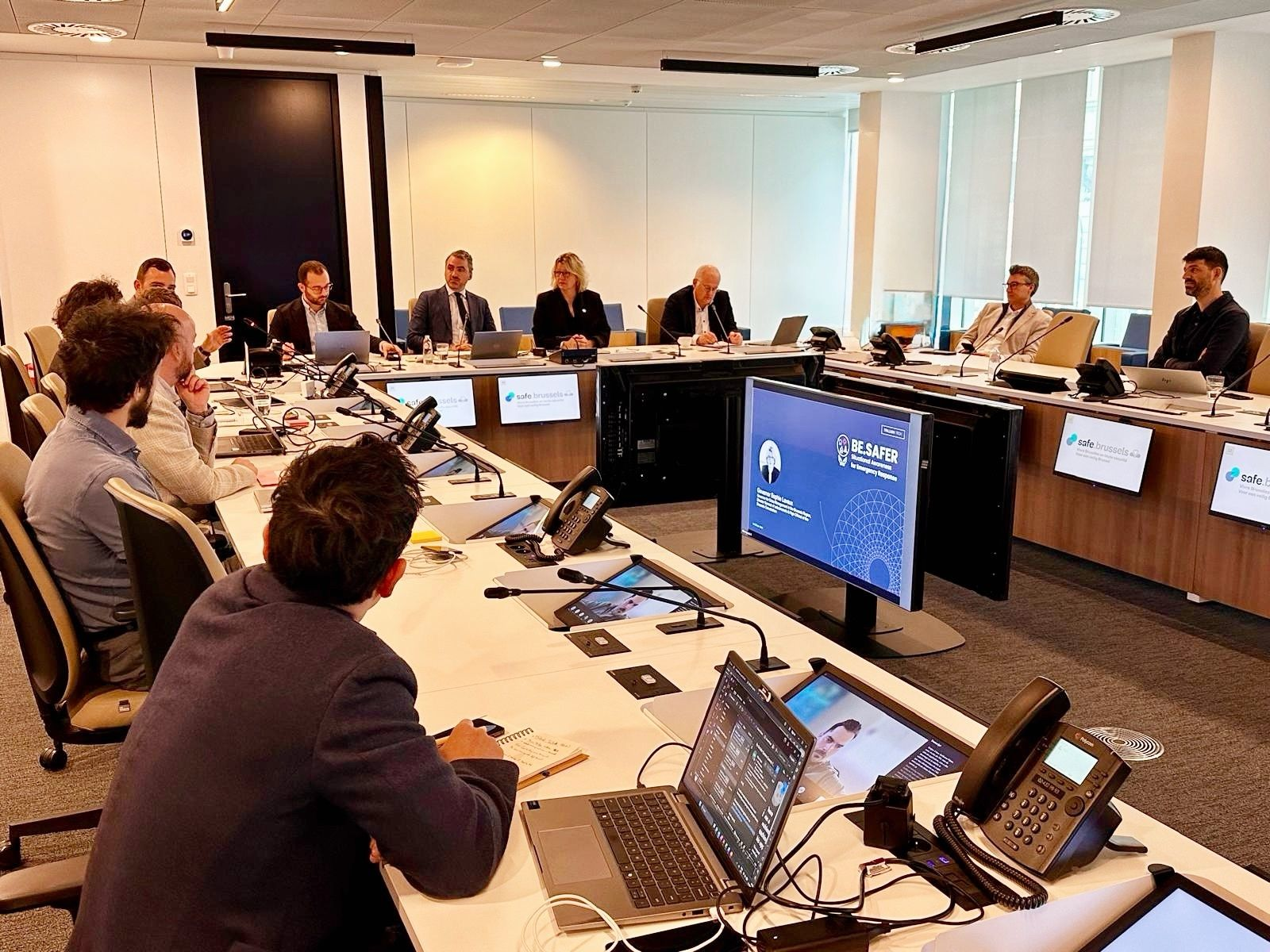
The Systems Summit is a high-intensity collaborative forum designed to convene the system, bringing together builders and beneficiaries to ensure the final tool addresses clear crisis response pain points and establishes human-level trust.
Be.Safer Systems Summit
21-22 May 2026
In-person at safe.brussels
with hybrid options available.
Resilience is now part of our everyday.
What to Expect: The "Systems Summit" Process
Unlike a traditional conference, this workshop uses an applied interdisciplinary framework to transition early-stage ideas into a technical roadmap.
Inspiration (Diverge): Mapping needs and opportunities while identifying "Builders" (engineers) and "Beneficiaries" (first responders).
Harvesting (Define): Small-group sessions using digital worksheets to factor in data, compute, and domain-specific considerations.
Mapping (Discover): Refining opportunities into concrete "features" and ranking them through collective voting.
Present (Converge): Identifying the future "AI Radar" and prioritizing specific Be.Safer requirements for real-world impact.
The Goal: Galactic Toolbox Lite
The summit establishes the basis for a prototype service grounded in operational reality, utilizing novel AI and space-enabled tools. Key technical features include:
Hazard Detection: Utilising satellite data (Copernicus Sentinel-1 and 2) for change detection to assess hazards like floods, fires, and landslides.
Smart Routing: A source-and-sink routing tool designed to evaluate evacuation options for mass events, such as those at the RSCA Lotto Park Stadium.
"Alpha" Demonstration: A field-ready release designed for training and benchmarking system performance limits.
Starting with a "Hindcast"
To manage complexity and compute costs, the operational test will be run as a hindcast MVP.
What it is: Re-simulating a historical scenario (such as the Wallonia Floods) with known parameters.
Why it matters: It allows for effective benchmarking and "Stress-Testing" to find failure modes and refine human-in-the-loop workflows before the system is used for live, life-or-death decisions.
What success looks like: System produces an end to end workflow that can run a hindcast scenario. Meaningful validation outputs are surfaced and potential limitations are exposed.
Deliverables & Logistics
Stakeholders will directly guide the technical and commercial roadmap to ensure these advancements align with the specific needs of safe.brussels.
Key Outputs: Validated user requirements, engineering work packages, and a formal Development Roadmap (D1.1).
Community Trust: Establishing a dedicated network of stakeholders across Police, Fire, and technical control room staff .
Summit Dates: 21 May (Main Summit) and 22 May (Optional technical/commercial deep dives).
Venue: Hosted in-person at safe.brussels, with hybrid participation available. To counter any language barriers google meet translate function will be used during feedback. During group discussion groups will be selected based on language.
Accommodations: Trillium staff will be staying at Motel One Brussels; preferential rates may be arranged.
Agenda
-
08:30 Arrival
Networking over tea/coffee.
09:00 Opening Session
Welcome remarks and introduction to the workshop's mission and goals.
09:15 Inspiration Session
Mapping needs and opportunities, with identification of “Beneficiaries” and “Builders” as well as platforms, tools and partners. Facilitated session includes discussion on emerging themes and insights on priorities and pain points in normal operation.
Invited Talk: Wallonia Floods - A hands-on account
11:00 Break
11:30 Harvesting Session
Breaking into smaller groups (3-5 per group), needs and potential opportunities are collated on digital worksheets, factoring data, compute and other domain specific considerations.
13:00 Lunch Break
14:00 Mapping Session
Needs and opportunities from previous sessions are refined into concrete ‘features’
and ranked and sorted through collective voting within teams.Facilitators provide hands-on guidance in this process and encourage cross pollination.
15:30 Break
16:00 Present Session
Teams present back, with future AI radar identified along with prioritisation
of Be.Safer requirements, i.e., what is needed for real impact?Closing remarks and summary of the “Systems Summit”.
17:00 Close
19:00 Dinner
Workshop dinner.
-
10:00 Arrival
10:15 Technical Requirements
Initial technical requirements discussion, with scoping and feasibility.
Framing of initial discovery prototype.11:00 Break
11:30 Ad-hoc
Technical and commercial ad-hoc meetings, which include user interviews.
13:00 Lunch Break
14:00 Ad-hoc
Technical and commercial ad-hoc meetings, which include user interviews.